
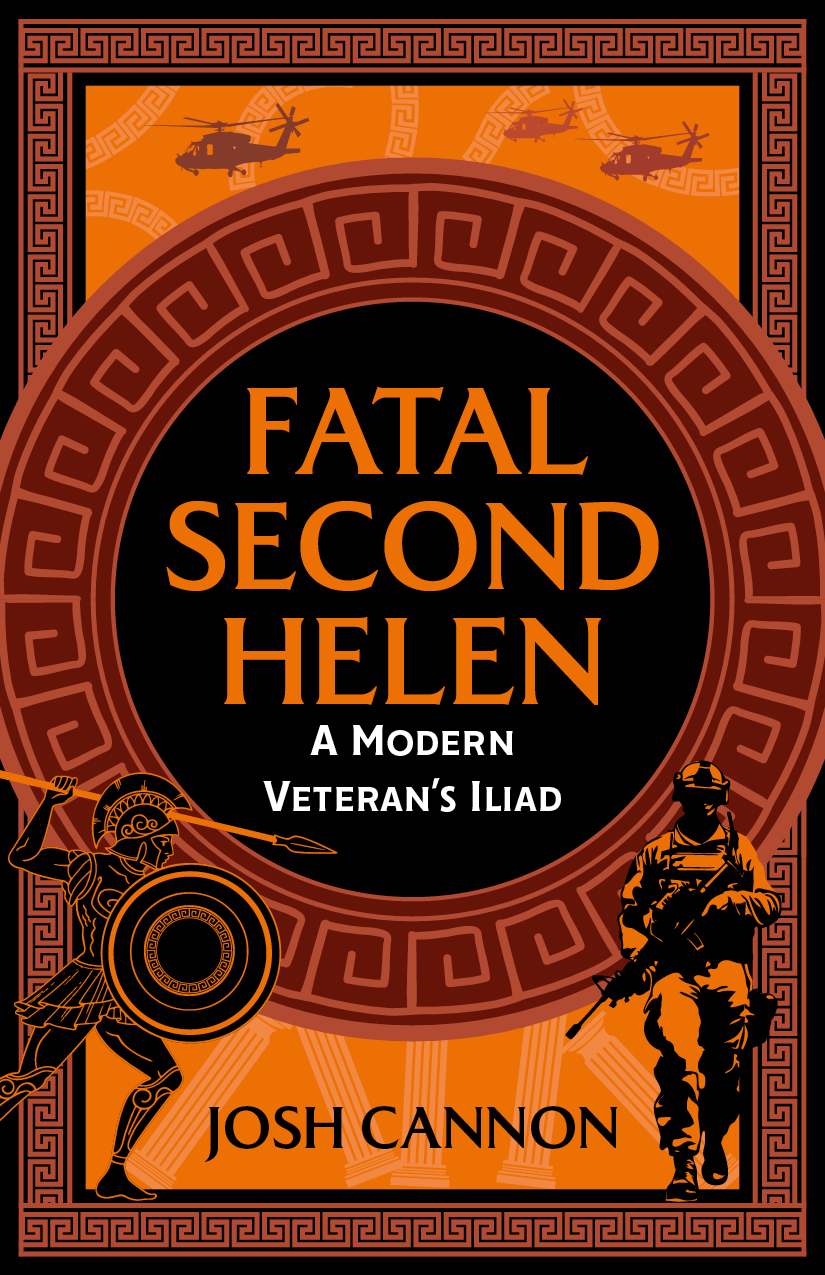
The Iliad from an Iraq War veteran’s perspective
Josh Cannon, PhD
University of Pittsburgh
The Iliad, Europe’s first book and oldest story of war, is at least 2600 years old. Read by leaders from Alexander the Great and Julius Caesar to Napoleon and Patton, this ancient epic has informed warfare spanning continents and millennia. What does it have to say to our current generation of war fighters and those that stand behind them?
Published by Blue Ear Books.
The Iliad tells the tale of the Trojan War through Achilles’ wrath and the devastation it brings not only to his enemies but to his own army. It presents warfare as the Ancient Greeks fantasized it would be: heroes with superhuman strength and shining armor fighting alongside the gods. Such a portrayal invites us to ask how this foundational story may overlook – or even glorify – the brutality of real warfare. Drawing on his own experiences as a combat veteran, Josh Cannon’s Fatal Second Helen explores this tension and reflects on what Homer’s Iliad can teach us about modern war.
Table of contents
Pages Chapters
1
Preface
9
Introduction
21
Chapter One: An Argument
29
Chapter Two: An Assembly and a Catalog
41
Chapter Three: A Duel and a Battle
51
Chapter Four: The Battle Rages
In the tradition of Jonathan Shay’s ‘Achilles in Vietnam’ (1994), Josh Cannon’s ‘Fatal Second Helen: A Modern Veteran’s Iliad’ brings to the audience a discussion of Homer’s Iliad that allows the ancient text to teach us about modern war. Cannon’s work differentiates itself from Shay’s by discussing the Iliad holistically. His book seeks to demystify the Iliad through connecting it to his military service via a presentation of his personal stories.
.
Cannon enlisted in the Marine Corps in 2000 and served in Iraq as an Arabic Cryptologic Linguist; he was part of the 2003 invasion, serving with 3rd Battalion, 1st Marines, and returned in 2004 with the 24 Marine Expeditionary Unit. Following his honorable discharge with rank of sergeant, he attended the University of Pittsburgh for his Bachelor of Philosophy, and then the University of Chicago, where he received his PhD in Near Eastern Languages and Civilizations. His research focused on the archaeology of the Hittites, a civilization contemporaneous with and neighboring ancient Troy. He is now faculty in the Classics Department at Pitt and works in the Frederick Honors College there.
.
By sharing his own experiences as a war veteran, an archaeologist, and a Classics professor, Cannon argues that the Iliad’s message is anti-war. For example, Cannon explains that Achilles, who was the finest fighter of his generation, was not an admirable character. His foil, Hector, was, in fact, a far better man. Hector did not want war; he wanted to protect his people. Cannon demonstrates that today’s military admires the traits exhibited by Hector more than those of Achilles and that we should, in fact, actively avoid the kind of destructive pride that Achilles embodies.
.
By sharing his story, Cannon’s book shares a new angle on an old tale. He makes the Iliad accessible to any audience and helps unearth a lesson that, despite being millennia old, still has much to teach us.